How to Prevent Marine Battery Terminal Corrosion Once and For All
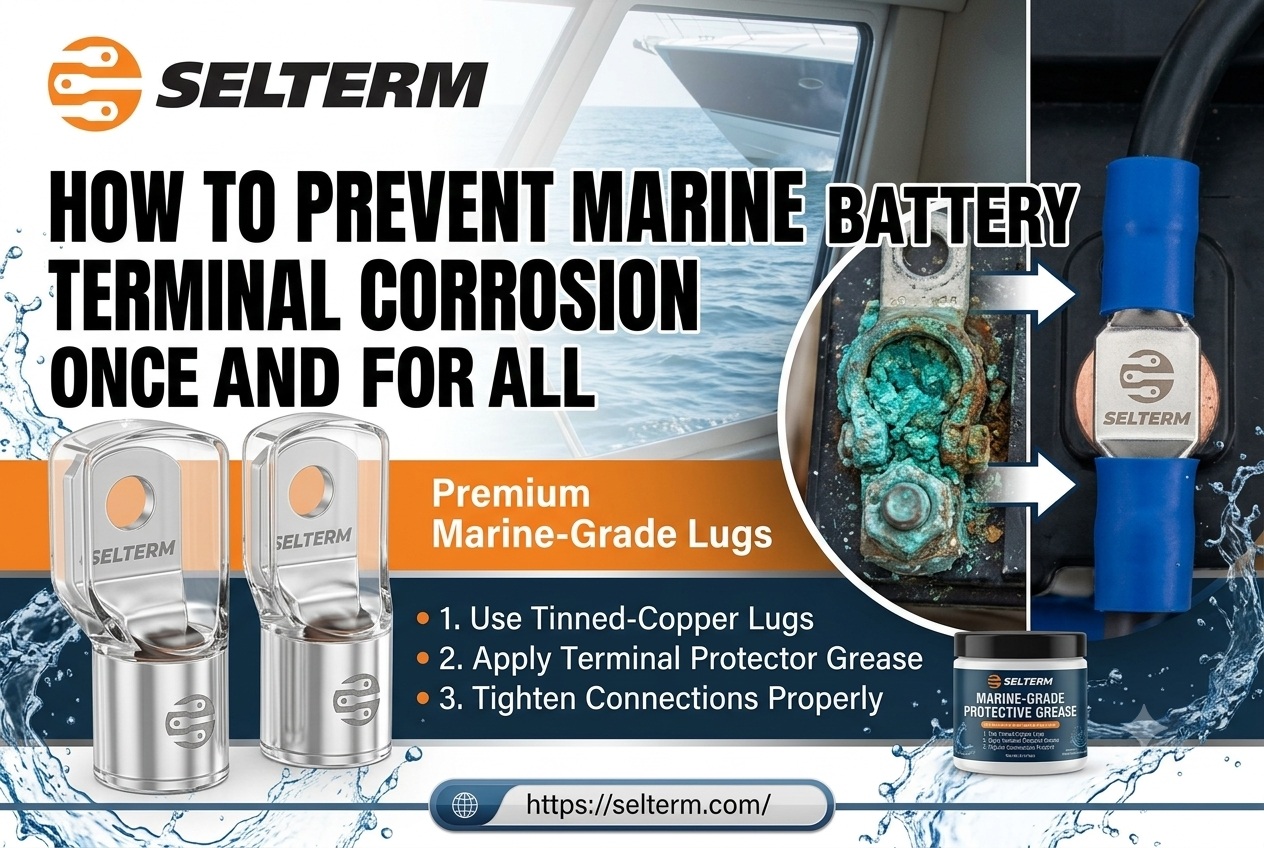
Salt air is patient. Battery terminals on a boat? That’s pretty much its favorite target.
If you’ve ever pulled back a rubber boot on your house battery bank and found a crusty green mess where clean metal used to be, you know the drill. Scrubbing it off with a wire brush and baking soda buys a few weeks. It doesn’t fix why it happened. Give it a month or two, and that chalky paste is right back.
Stopping marine corrosion for good means changing how the connection is built from the ground up like marine grade battery lugs
The Real Reason Terminals Rot So Fast
A boat terminal isn’t just dealing with damp sea air. It lives in a small, unvented box right next to a battery that off-gasses while charging.
Standard lead-acid batteries vent tiny amounts of acidic vapor whenever the alternator runs or you’re hooked up to shore power. Acid settles on the nearest metal. On top of that, your engine bay cycles heat every single day. It warms up, cools off, condenses moisture, mixes with acid residue, and evaporates.
When the water dries off, a concentrated layer of salt and acid remains. Over a season, that crust creeps between the terminal post and the lug. Resistance shoots up. Voltage drops. Eventually, your engine hesitates or your chartplotter reboots every time you crank the starter.
Cheap Hardware Is the Main Culprit
Most terminal problems start at the local auto parts store.
Standard bare copper lugs work fine in a car or a dry garage. Copper carries current well, but salt air eats it alive. The second raw copper hits marine humidity, it oxidizes. First it goes dark, then it turns bright green. Once that crust forms, electricity can’t flow through it smoothly anymore.
That’s why boat wiring calls for marine grade battery lugs. They still have a heavy copper core inside so you keep full conductivity, but the outside is electro-plated in tin. Tin doesn’t react to saltwater or acid vapors like bare copper does. It stays clean and maintains a solid connection year after year.
Putting raw copper wire connectors into a bilge is basically scheduling an electrical failure for next season.
The Invisible Corrosion Inside Your Wiring
Even a good tin-plated lug will fail if moisture gets inside the wire itself.
Basic electrical lugs have an open back where the strands go in. You crimp it down, but the back end stays exposed to air. On the water, moisture gets sucked right up into those wire strands through capillary action—just like water up a paper towel.
The copper rots inside the insulation where you can’t see it. The terminal lug might look shiny on the outside, but the wire underneath turns into black, brittle dust.
To stop that, you need adhesive-lined heat shrink tubing.
Slide a piece of dual-wall heat shrink over the lug barrel and hit it with a heat gun. The outer wall shrinks tight, and the inner lining melts into a thick glue. That glue squeezes into every tiny gap between the cable jacket and the lug. Once it cools, it creates a solid, waterproof plug. Salt air can’t get inside, water can’t travel up the wire, and the core stays untouched.
Getting a complete kit or buying marine battery cable ends lugs that come paired with heavy adhesive heat shrink saves you the hassle of trying to match up sizes later. Skipping glue-lined heat shrink leaves the most fragile part of your wire totally unprotected.
Protecting the Post
With the cable crimped and sealed shut, you have one spot left to protect: where the flat ring sits on the battery post or stud.
Once the nut is torqued down, spread a light layer of dielectric grease or terminal protector over the hardware. Dielectric compounds don’t conduct electricity—which throws some people off—but that’s the point. It fills the tiny air pockets and microscopic gaps around the hardware where moisture likes to sit. Since the flat metal faces are already clamped tight together, the grease seals the outer edges so salt air can’t sneak in.
Slipping pre-treated felt washers over the posts before dropping the lugs adds another simple barrier against acid vapor.
Keep It Simple
If you build cables with tin-plated lugs, crimp them solid, and seal the ends with adhesive shrink, you won’t be scrubbing green powder off your batteries every spring.
All you have to do once a year during commissioning is pop the terminal boots off and take a look. Make sure the heat shrink isn’t chafing against anything, check that the terminal nuts haven’t vibrated loose, and wipe on a fresh coat of grease if the old stuff looks dry. Using proper marine grade battery lugs right from the start means your hardware stays clean beneath the protective coating.
It takes an extra five minutes when assembling the cables, but it completely eliminates the random electrical gremlins that like to show up when you’re five miles offshore.
FAQ
Why do my boat’s battery terminals corrode so much faster than my car’s?
Boats live in a uniquely harsh combination of conditions — salt air, battery off-gassing, temperature swings, and constant humidity. Cars, even ones parked outside, rarely deal with all of those simultaneously. The marine environment is just significantly more aggressive on metal.
What’s the difference between a regular copper lug and a marine grade battery lug?
Marine grade battery lugs have a tin plating over the copper that resists corrosion in salt air and humid environments. Regular bare copper lugs oxidize quickly when exposed to moisture and salt — fine for dry installations, wrong choice for a boat.
Do I really need heat shrink on every terminal?
On a boat, yes. The heat shrink — specifically adhesive-lined dual-wall tubing — seals the back of the barrel where the wire enters the lug. Without it, moisture works its way in from that opening and corrodes the connection from the inside.
How often should I inspect marine battery terminals?
Once a year at minimum. Start of the season is the best time — before you’re back on the water and depending on those connections.
Can I use dielectric grease on tinned copper lugs?
Yes. Dielectric grease applied over the stud connection after the lug is bolted down adds another layer of moisture protection. It doesn’t affect the electrical connection and helps keep salt air from settling around the terminal.
What size marine lug do I need?
Match the lug to your cable gauge and the stud diameter on your battery post or busbar. A lug labeled for 4 AWG goes on 4 AWG cable. The stud hole size — typically 5/16″ or 3/8″ for most marine battery posts — needs to match the bolt diameter.